Rainwater Harvesting NZ: Systems, Savings & Sustainable Living
Unlock Independence, Reduce Bills, and Embrace Eco-Friendly Water Management.
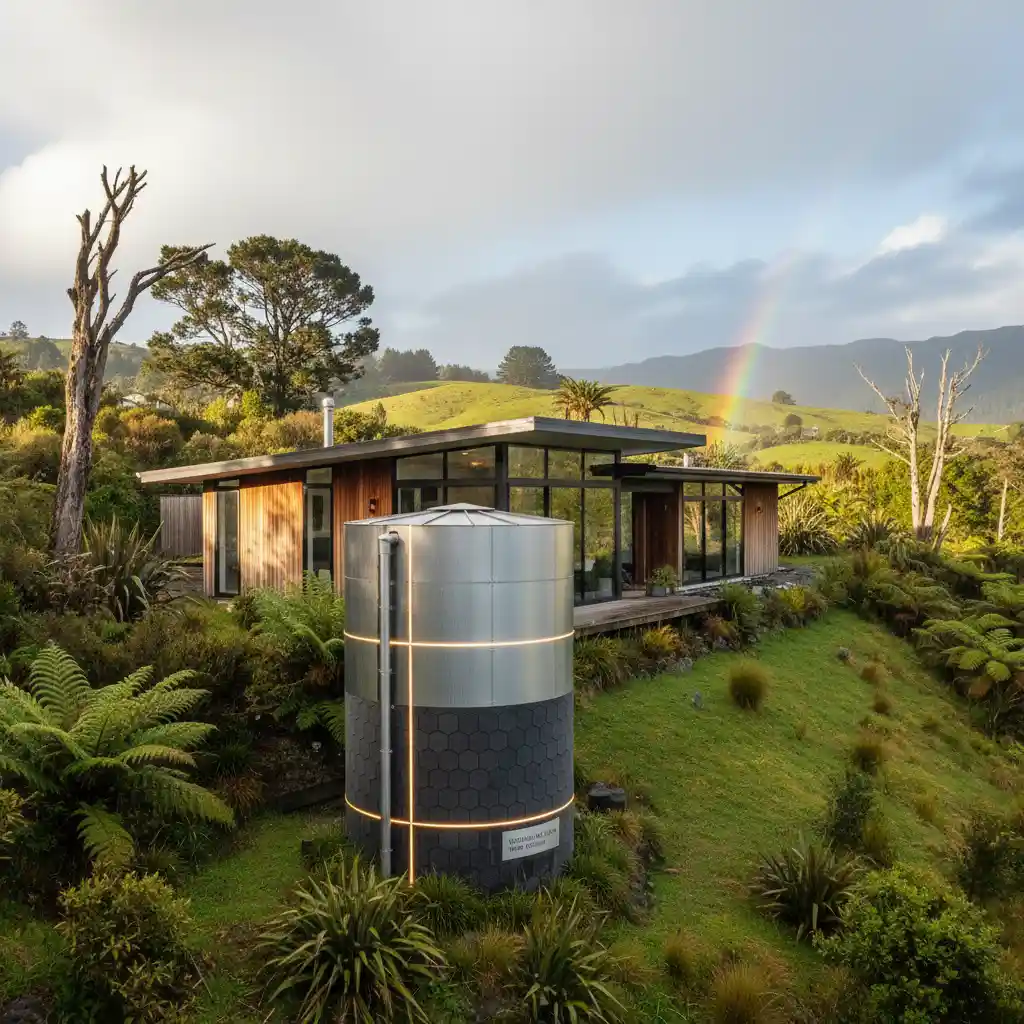
In a world increasingly focused on sustainability, rainwater harvesting in NZ offers a practical and powerful solution for homeowners looking to reduce their environmental footprint and save money. Imagine tapping into an abundant, free resource that falls right onto your roof. For many New Zealanders, this isn’t just a dream; it’s a tangible reality that provides water security, lowers utility bills, and fosters a deeper connection to sustainable living.
Whether you’re rural, urban, or simply seeking greater self-sufficiency, understanding the ins and outs of rainwater harvesting systems is your first step. This comprehensive guide will walk you through the benefits, types of systems, installation considerations, and the significant financial savings you can achieve.
Table of Contents
Benefits of Rainwater Tanks for Homes
Opting for a rainwater harvesting system is more than just an eco-conscious choice; it’s a smart investment with a multitude of advantages for your home and lifestyle. Especially in New Zealand, where water conservation is becoming increasingly important, these systems offer unparalleled value.
- Reduced Water Bills: This is often the primary driver for homeowners. By supplementing or even replacing your mains water supply for non-potable uses (or even potable, with proper filtration), you significantly cut down on your monthly water expenditure.
- Increased Water Independence: Gain control over your water supply, reducing reliance on municipal systems that can be affected by droughts, infrastructure issues, or price hikes.
- Environmental Stewardship: By collecting rainwater, you reduce stormwater runoff, minimise the strain on local water treatment plants, and contribute to overall water conservation efforts.
- Better for Gardens & Landscaping: Rainwater is naturally soft and free of chlorine and other chemicals found in treated tap water, making it ideal for watering plants, gardens, and lawns. Your plants will thank you!
- Emergency Water Supply: In the event of a natural disaster or mains water supply interruption, a full rainwater tank provides a crucial backup source for essential needs.
- Offsetting Water Restrictions: During dry spells and council-imposed water restrictions, your harvested rainwater can keep your garden thriving when others are struggling.
Stat Callout: A typical New Zealand household uses approximately 200-250 litres of water per person per day. Up to 50% of this can be replaced by harvested rainwater for non-potable uses like toilet flushing, laundry, and gardening, leading to substantial savings!
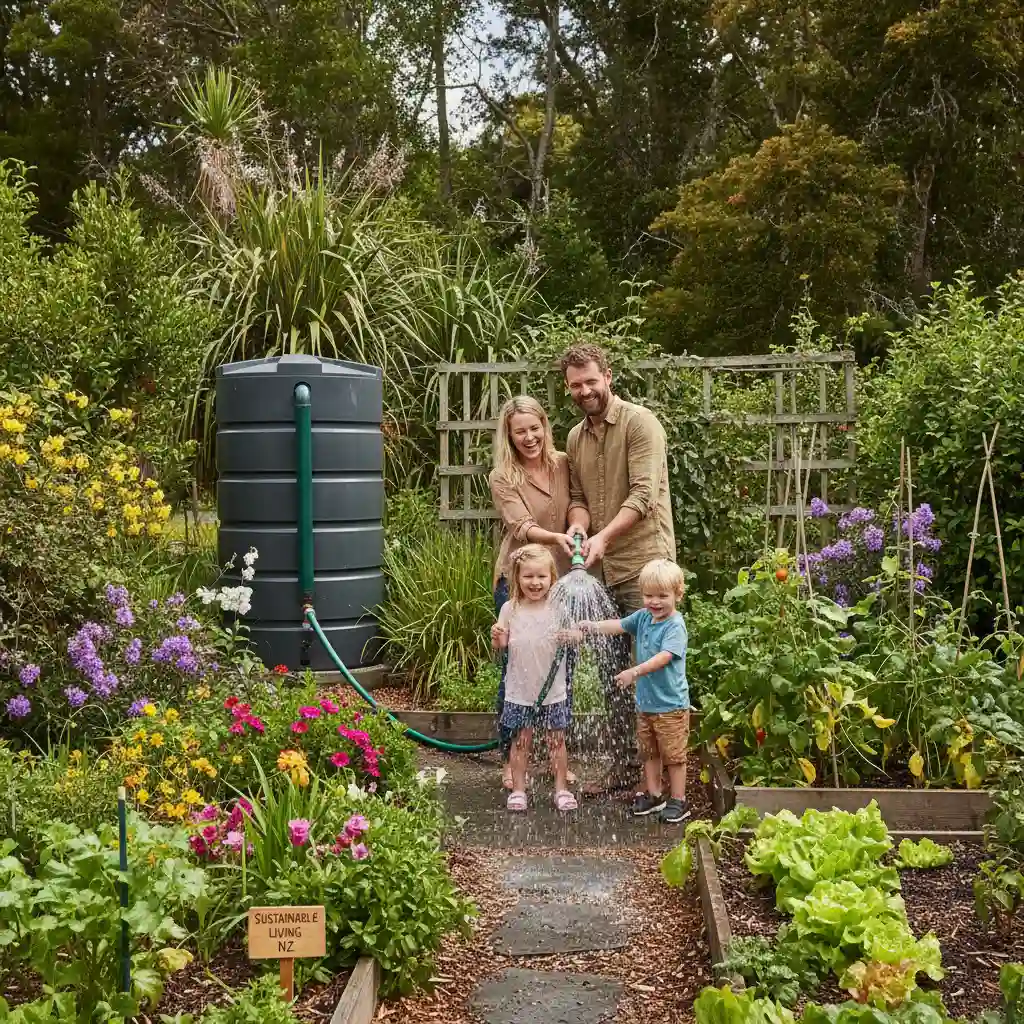
Types of Rainwater Harvesting Systems in NZ
Choosing the right system for your home depends on your water needs, budget, space availability, and desired level of integration. Here’s a look at the common types of rainwater harvesting systems available in NZ:
1. Basic Non-Potable Systems (Outdoor Use)
- Description: Simple setup for garden irrigation, car washing, and other outdoor tasks. Water is collected from the roof via gutters and directed into a single tank, often with a basic filter (leaf diverter).
- Components: Roof, gutters, downpipe diverter, small-to-medium sized tank (e.g., 200-2,000 litres), overflow outlet, tap/hose connection.
- Best For: Budget-conscious homeowners, those with smaller gardens, or as a starting point for rainwater harvesting.
2. Whole-House Non-Potable Systems (Indoor & Outdoor)
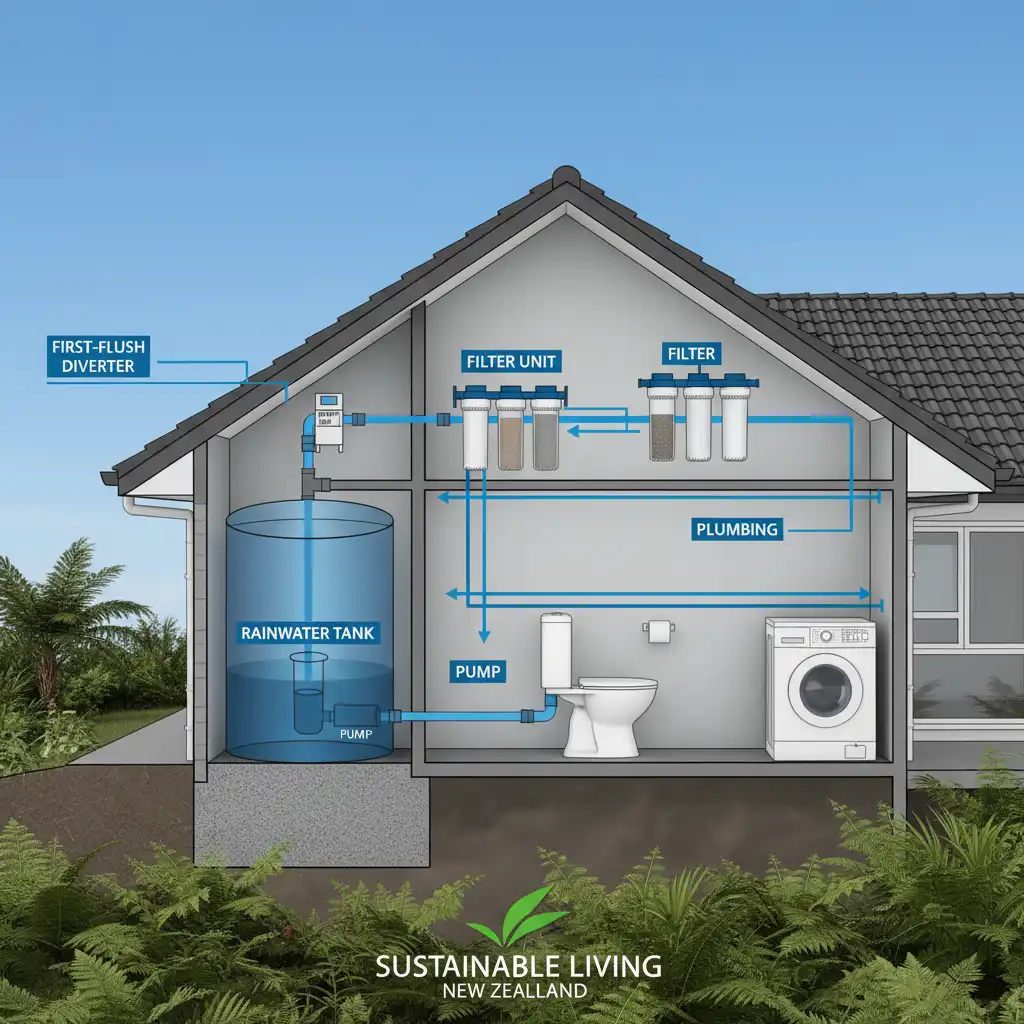
- Description: More advanced, these systems feed rainwater to toilets, washing machines, and outdoor taps. Requires a pump to pressurise the water and a dedicated plumbing line.
- Components: Roof, gutters, first-flush diverter, leaf screen, multiple or larger tanks (e.g., 5,000-30,000+ litres), pump, pressure controller, internal non-potable plumbing.
- Best For: Significant water bill reduction, greater independence, and a desire to maximise rainwater use without full potable treatment.
3. Potable Rainwater Systems (Drinking Water Quality)
- Description: The most comprehensive system, designed to provide water safe for drinking, cooking, bathing, and all household uses. Involves rigorous filtration and often UV sterilisation. Essential for homes without access to a municipal supply.
- Components: All components of a whole-house system, plus advanced multi-stage filtration (sediment, carbon filters), UV sterilisation unit, potentially a backup mains water connection with an automatic switchover valve.
- Best For: Off-grid living, rural properties, or ultimate water independence where mains water isn’t available or desired for all uses.
| Feature | Basic Non-Potable | Whole-House Non-Potable | Potable System |
|---|---|---|---|
| Primary Use | Outdoor (Garden, Car Wash) | Outdoor + Toilets, Laundry | All Household Uses (Drinking, Bathing) |
| Typical Tank Size | 200 – 2,000 Litres | 5,000 – 30,000+ Litres | 10,000 – 50,000+ Litres |
| Filtration Level | Leaf Diverter/Screen | First-flush, Mesh Filter | Multi-stage (Sediment, Carbon, UV) |
| Pump Required | Optional (Gravity-fed possible) | Yes, for internal use | Yes, high-quality |
| Complexity / Cost | Low | Medium | High |
Installation Costs & Permitting in NZ
The upfront investment for a rainwater harvesting system in NZ varies significantly based on its complexity, tank size, and installation requirements. Understanding these costs and the necessary permitting is crucial for planning.
Typical Cost Breakdowns:
- Basic Non-Potable System: Expect to pay anywhere from NZD $1,500 to $4,000+ for a small-to-medium tank (1,000-5,000 litres) and basic connection. This often includes the tank, a simple pump (if needed), and installation.
- Whole-House Non-Potable System: These systems, including larger tanks (10,000-30,000 litres), more robust pumps, and internal plumbing connections, typically range from NZD $5,000 to $15,000+.
- Potable Rainwater System: For a full potable system with advanced filtration and UV sterilisation, especially for larger homes or rural properties, costs can range from NZD $15,000 to $30,000+. This includes extensive plumbing work and high-grade components.
Factors influencing cost include tank material (polyethylene, concrete, steel), tank size, pump quality, filtration system sophistication, site accessibility, and labour rates.
Permitting and Regulations in New Zealand:
Navigating local council regulations is a critical step. While rainwater harvesting in NZ is generally encouraged, specific rules apply:
- Building Consent: For tanks over a certain capacity (often 2,000-5,000 litres, check with your local council), a building consent may be required. This ensures the tank’s structural integrity, foundation, and placement meet safety standards.
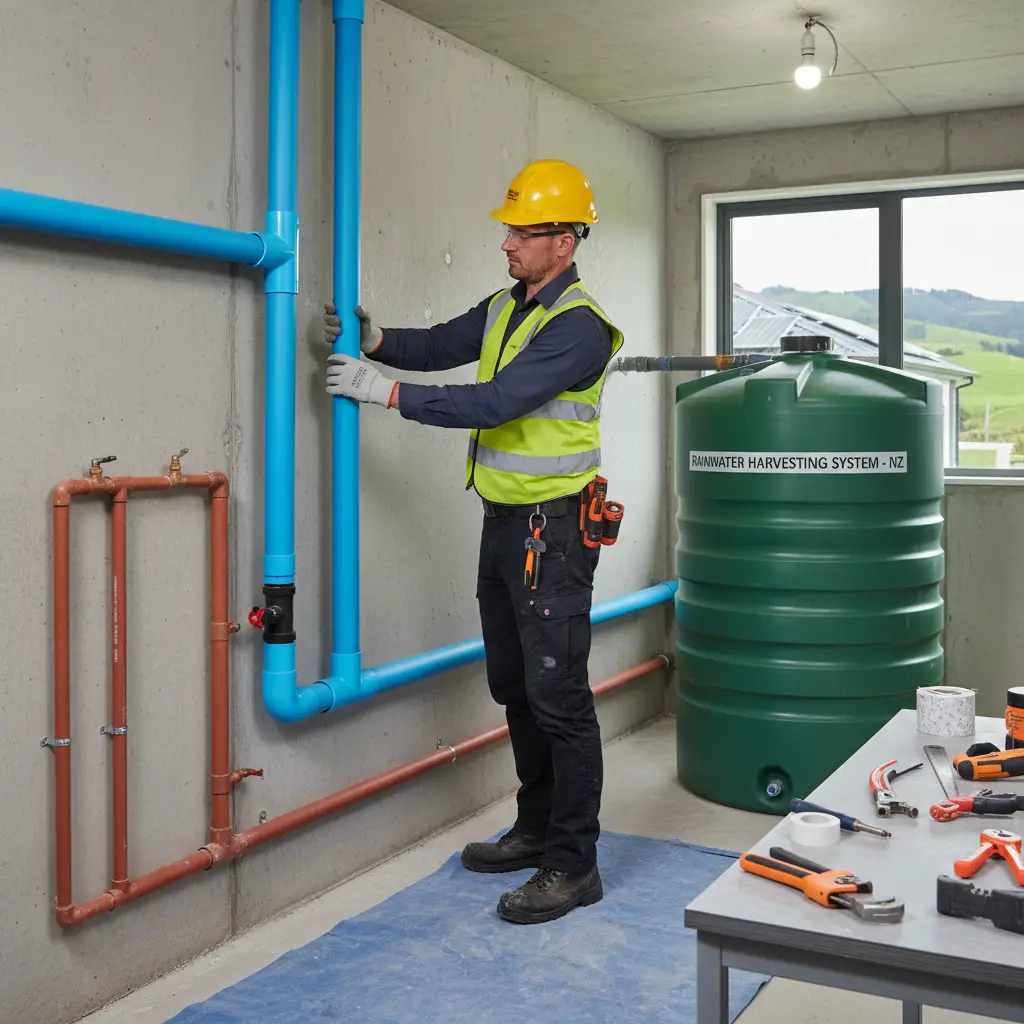
- Plumbing Regulations: If connecting rainwater to internal plumbing (non-potable or potable), a licensed plumber must do the work, and it usually requires a plumbing consent. This ensures there’s no cross-connection with the mains supply and that all health and safety standards are met.
- Potable Water Standards: If intending to drink the water, you must meet the Ministry of Health’s Drinking Water Standards for New Zealand. This typically involves advanced filtration, UV treatment, and regular testing.
- Roof Material: Ensure your roof material is suitable for collecting drinking water if going for a potable system (e.g., avoid lead flashing or certain treated timbers).
Expert Tip: Always consult your local council early in the planning process. They can provide specific guidelines, forms, and advice tailored to your region. Engage a reputable installer who is familiar with NZ regulations.
Calculating Water Bill Reductions
The financial return on investment (ROI) is a significant motivator for installing a rainwater harvesting system. Calculating your potential savings involves understanding your current water usage and costs.
Steps to Estimate Your Savings:
- 1. Determine Current Usage: Look at your past water bills to find your average monthly or quarterly water consumption in cubic metres (m³).
- 2. Identify Water Costs: Note down the cost per m³ from your bill. Remember that sewerage charges are often linked to water consumption, so reducing water use can also reduce these charges.
- 3. Estimate Rainwater Potential: Consider your roof area and average annual rainfall in your region. A simple calculation:
Roof Area (m²) x Annual Rainfall (mm) = Annual Rainwater Harvest (Litres). - 4. Calculate Replacement Volume: Decide what percentage of your household water you intend to replace with rainwater. For non-potable uses like toilets and laundry, this could be 30-50%. For full potable systems, it could be 80-100%.
- 5. Project Annual Savings: Multiply your replaced water volume by your cost per m³. Don’t forget to factor in reduced sewerage charges if applicable.
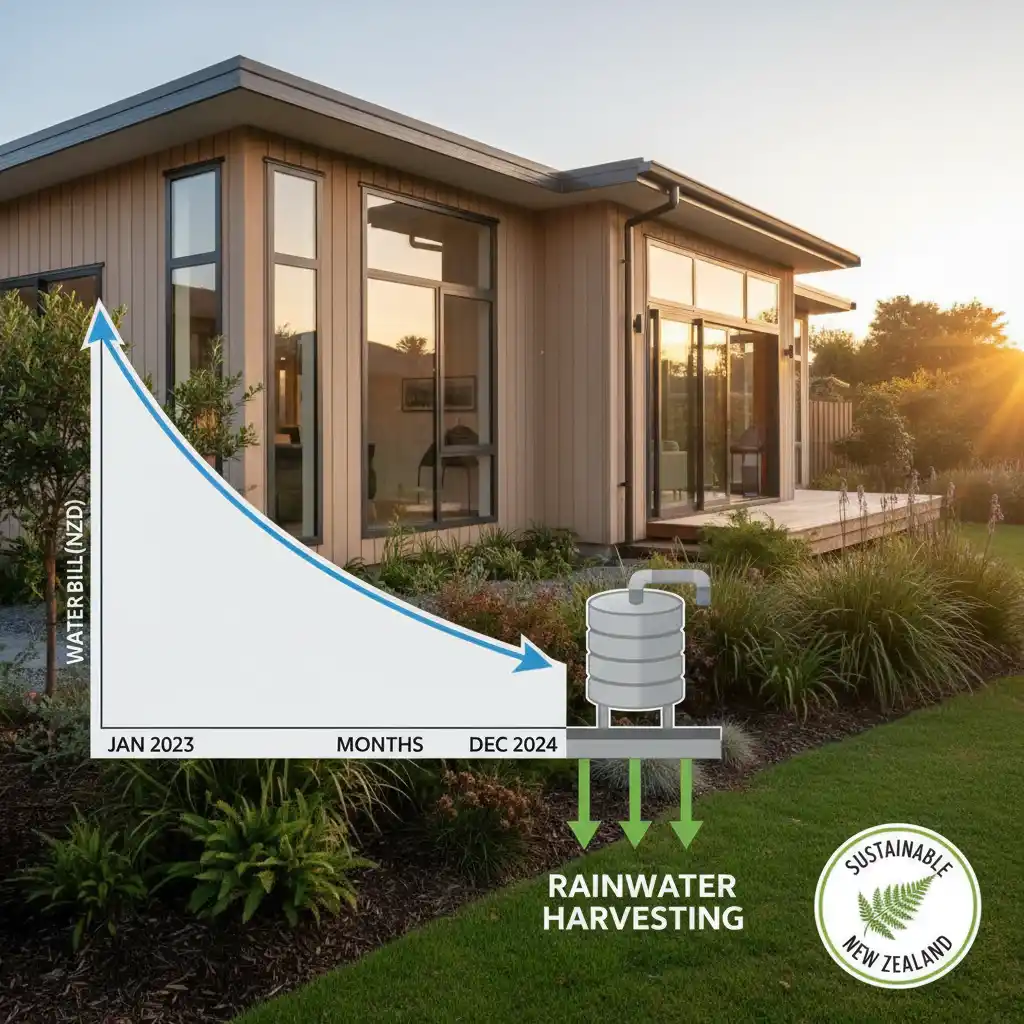
Stat Callout: With average water charges in NZ ranging from NZD $1.50 to $4.00 per cubic meter (plus similar sewerage charges), a 20,000-litre tank replacing just 20% of a family’s water use could save hundreds of dollars annually, leading to payback periods of 5-10 years for many systems.
While there’s an initial investment, the long-term benefits of reduced bills, increased property value, and water security make rainwater harvesting in NZ a compelling option for sustainable living. Many homeowners find that their systems pay for themselves within a decade, after which the water is essentially free.
Frequently Asked Questions (FAQ) about Rainwater Harvesting NZ
Is rainwater safe to drink in New Zealand?
Yes, with proper filtration and purification (e.g., multi-stage filters, UV sterilisation), rainwater can be made safe for drinking. For potable systems, it’s crucial to follow the Ministry of Health’s Drinking Water Standards for New Zealand and regularly test your water quality. Many rural homes rely solely on harvested rainwater for all their needs.
How much does a typical rainwater tank cost in NZ?
Tank prices vary significantly based on material (polyethylene, concrete, steel) and size. A basic 1,000-litre tank might start from NZD $500-$1,000, while a larger 25,000-litre tank could be NZD $4,000-$8,000+. Installation and additional components (pumps, filters) will add to the overall cost, typically bringing a full system to NZD $1,500 to $30,000+.
Do I need council consent for a rainwater tank in NZ?
For smaller tanks (often under 2,000-5,000 litres, depending on local bylaws), you might not need building consent. However, for larger tanks or if connecting to internal plumbing, building and/or plumbing consents are typically required. Always check with your local council before installation to understand specific regulations in your area.
What size rainwater tank do I need?
Tank size depends on your household’s water consumption, roof area, average local rainfall, and desired level of water independence. A general rule of thumb for full household use in NZ is 25,000-30,000 litres for a family of four, but smaller tanks are suitable for supplementary uses. A professional installer can help you calculate the optimal size.
How often do rainwater tanks need cleaning?
Regular maintenance is key. Guttering and leaf screens should be cleared quarterly. Tanks themselves typically require cleaning every 2-5 years, or more often if you notice debris build-up or changes in water quality. First-flush diverters should be inspected and cleaned every 6-12 months.
References & Further Reading
- Ministry of Health, New Zealand. (Current Edition). Drinking Water Standards for New Zealand. health.govt.nz/drinking-water
- BRANZ. (Ongoing Research). Rainwater Harvesting Guidance. branz.co.nz/rainwater-harvesting
- Local Government New Zealand. Council Building Consents & Regulations. (Consult your specific local council website, e.g., Auckland Council, Wellington City Council for local bylaws)
- Watercare Services Ltd. Water Charges Information. watercare.co.nz/prices (Example for Auckland, check your local provider)
- EECA (Energy Efficiency and Conservation Authority). Water Heating & Conservation. eeca.govt.nz/water-heating